How to Choose a Blood Pressure Monitor for Home Use in Kenya
High blood pressure is often called a silent condition because many people feel completely well while it slowly strains the heart, brain and kidneys. That is why more Kenyan families now check blood pressure at home. This guide explains how home monitors work, which features matter, and how to take a reading you can trust.
 Global Max Shop Team · 7 min read
Why home blood pressure monitoring matters
High blood pressure, or hypertension, is one of the most common health conditions among adults in Kenya, and many people who have it do not know. It usually has no symptoms until it causes a serious problem such as a stroke, heart attack or kidney disease. Regular checks are the only way to know your numbers.
A home monitor does not replace your doctor, but it gives your doctor much better information. A single reading at a clinic can be higher than normal because of rushing to the appointment or feeling anxious, a pattern often called white coat hypertension. Readings taken calmly at home over several days show a truer picture. For people already on treatment, home readings help the doctor see whether the medicine is working.
Understanding the numbers
A blood pressure reading has two numbers, measured in millimetres of mercury (mmHg). The top number, systolic pressure, is the pressure in your arteries when the heart beats. The bottom number, diastolic pressure, is the pressure when the heart rests between beats. A reading of 120/80 mmHg is read as "120 over 80". Most monitors also show your pulse rate.
As a general guide for adults, readings around 120/80 are considered normal, and readings that are repeatedly 140/90 or higher at the clinic, or a little lower at home, may indicate high blood pressure. Your doctor will interpret your readings and set targets for you personally. Seek urgent medical care if you get a very high reading together with symptoms such as chest pain, severe headache, confusion, weakness on one side of the body or difficulty speaking.
 Omron M2 Basic Automatic Blood Pressure MonitorOrder on WhatsApp
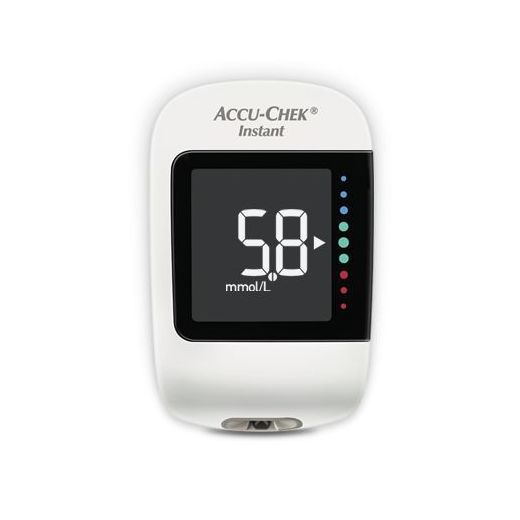 Accu-Chek Instant Blood Glucose MeterOrder on WhatsApp
 Microlife NC 200 Non-Contact Forehead ThermometerOrder on WhatsApp
Upper arm or wrist monitor?
Upper arm monitors are the type most doctors and guidelines recommend for home use. The cuff sits on the upper arm at the same level as the heart, which makes readings more consistent.
Wrist monitors are smaller, lighter and easier to carry. They can be useful for people whose upper arm is too large for standard cuffs or who find arm cuffs uncomfortable. However, readings are very sensitive to position: the wrist must be held exactly at heart level, and small changes in posture can change the result. If you choose a wrist monitor, follow the positioning instructions carefully.
Getting the right cuff size
The cuff size is one of the most overlooked details, and one of the most important. A cuff that is too small gives falsely high readings; a cuff that is too large can give falsely low readings. Measure around the middle of your upper arm with a tape measure and compare it with the cuff range printed on the box, for example 22 to 32 cm or 22 to 42 cm. Many monitors come with a standard cuff, and larger cuffs can be bought separately. Wide-range cuffs suit most adults.
Features worth paying for
- Clinical validation: look for a monitor that has been clinically validated for accuracy. Established brands publish this information.
- Automatic inflation: one-button operation is easier and more consistent than manual pumping.
- Memory: storing readings with the date and time makes it easy to show your doctor a pattern. Some monitors store readings for two users.
- Irregular heartbeat detection: a symbol alerts you if your heartbeat was irregular during the measurement, which is worth mentioning to your doctor.
- Averaging: some monitors average several readings automatically.
- Large display: important for older relatives or anyone with poor eyesight.
- Power options: batteries plus an optional mains adapter are convenient during power cuts.
How to take an accurate reading
- Avoid caffeine, smoking and exercise for 30 minutes before measuring, and empty your bladder.
- Sit in a chair with your back supported and your feet flat on the floor. Do not cross your legs.
- Rest quietly for five minutes.
- Rest your arm on a table so the cuff is at heart level. Wrap the cuff on bare skin, not over a sleeve, about two to three centimetres above the elbow.
- Stay still and silent during the measurement.
- Take two readings one minute apart and record both, or let the monitor store them.
- Measure at the same times each day, for example morning before medication and evening before dinner, as your doctor advises.
Common reasons for inaccurate readings
- Talking or moving during the measurement can add several points to the result.
- An unsupported arm hanging by your side gives a higher reading than one resting at heart level.
- A cuff over clothing or a rolled-up tight sleeve squeezes the arm and affects the result.
- A full bladder can raise blood pressure slightly.
- Measuring straight after exercise, a meal, tea, coffee or a cigarette gives a temporary high.
- Crossed legs can raise systolic pressure.
- Taking only one reading. The first reading is often the highest; averaging two or three is more reliable.
If your readings jump around a lot, review this list before assuming the monitor is faulty.
Lifestyle habits that support healthy blood pressure
Monitoring is most useful when combined with healthy habits. Reducing salt is one of the most effective changes: use less salt when cooking, taste food before adding more, and limit processed snacks and stock cubes. Eat plenty of vegetables, fruit, beans and whole grains such as wimbi and brown ugali. Stay active with at least 30 minutes of brisk walking on most days. Limit alcohol, stop smoking, manage stress and aim for good sleep. If you are on medication, take it exactly as prescribed even when you feel well, and never stop without speaking to your doctor.
Keeping a blood pressure diary
Your readings are most useful when they are recorded consistently. Note the date, time, both numbers, pulse and anything unusual, such as feeling unwell or missing a dose of medication. Many people keep a simple notebook; others use the monitor's memory or a phone app. Bring the record to every clinic visit. A week of readings before an appointment is often more valuable to your doctor than a single measurement on the day.
Monitoring for the whole family
One monitor can serve the whole household, which makes it good value. Many models store readings for two users separately. If grandparents live with you or nearby, a monitor with a large display and simple buttons makes it easier for them to check their own pressure. Encourage adult family members, especially those over 40 or with a family history of high blood pressure, diabetes or stroke, to check their numbers at least occasionally. Early detection gives the best chance to manage blood pressure with lifestyle changes and, where needed, treatment.
Caring for your monitor
- Store the monitor and cuff in their case, away from heat and moisture.
- Do not fold the cuff tightly or twist the tubing.
- Replace batteries when the low-battery symbol appears, because weak batteries can affect readings.
- Have the accuracy checked every year or two by comparing it with a clinic monitor.
Other healthcare products for the home
Many families keep a small set of healthcare products at home. A glucometer helps people living with diabetes track blood sugar. A digital or non-contact thermometer is useful for checking fevers in children. A basic first aid kit with plasters, bandages and antiseptic covers small injuries. Browse all healthcare equipment and medical essentials.
Buy health products online in Kenya
Global Max Shop makes it easy to buy health products online in Kenya. The Omron M2 Basic upper arm monitor is a trusted, easy-to-use choice for most households. Tap Order on WhatsApp on any product, and our team will confirm the price, cuff size and warranty before you pay. Explore our full range of health products, including vitamins and supplements. As always, home monitoring supports, but does not replace, care from your doctor.
Frequently asked questions
What is a normal blood pressure reading?
Around 120/80 mmHg is generally considered normal for adults. Your doctor will advise on your personal targets.
How often should I check my blood pressure at home?
Follow your doctor's advice. Many people check twice a day, morning and evening, for a week before a clinic visit.
Are wrist blood pressure monitors accurate?
They can be, but readings vary more with position. Upper arm monitors are usually preferred for home use.
Why do my readings differ between arms?
Small differences are normal. Use the arm with the higher reading consistently, and tell your doctor about large differences.
Why is my reading higher at the clinic?
Stress and rushing can raise blood pressure at appointments. Home readings taken calmly give your doctor a fuller picture.
Can I buy a blood pressure monitor online in Kenya?
Yes. Order on WhatsApp from Global Max Shop and we deliver countrywide after confirming the model and price.
Need help choosing?
Send us a message and our team will recommend products and confirm today's prices.
We are a Nairobi-based online store helping Kenyans shop beauty, health, food, school and farm products with confidence. Our guides are general information, not medical or professional advice.